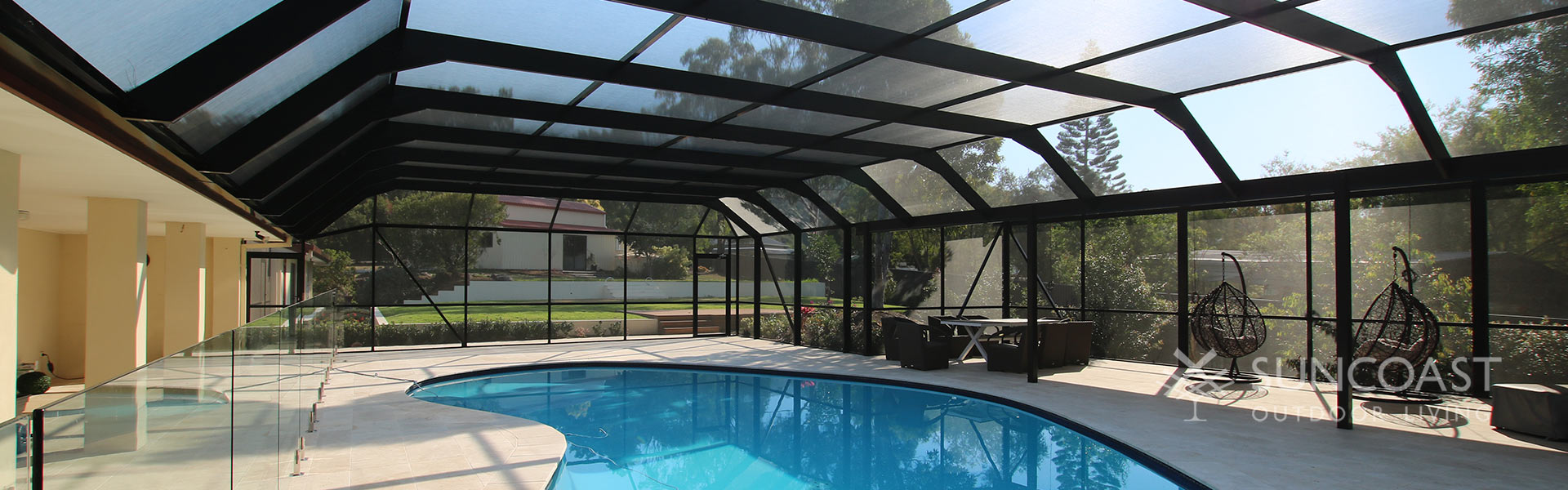
Most people start with the wrong question when choosing a screen for their outdoor enclosure. They ask which mesh is best, when what matters is what they need the space to do.
A household losing summer evenings to mosquitoes has different priorities from one screening a pool area, one with a cat that climbs every surface, or one that bought the property for the view.
We design and install custom enclosures across South East Queensland, and we work with seven screen types for exactly that reason. Here is how to work out which suits yours.
What is the best screen for a patio enclosure?
There is no single best screen. Standard insect screening handles mosquitoes and flies. A finer midge mesh is needed where midges and sand flies are the problem. Pet households need the tear-resistant Tuffscreen. Pool areas that form part of the safety barrier need one of the two screens approved for that use. Where the view matters most, the BetterVue is built for clearer views.
Key takeaways
- There is no single best screen. The right mesh depends on the insects, environment and way the enclosure will be used.
- Tighter weaves stop smaller insects but let less light through. Our Pool and Patio Screen has a shade factor of 25%, the Tuffscreen 42% and the Midge Screen 46%.
- Two screens can form part of a compliant pool barrier when installed with our aluminium extrusion and spline system: the Midge Screen and the Tuffscreen Pet Mesh. The Tuffscreen is also suitable for first-floor balustrading applications with our framing system.
- Pet households need tear and puncture resistance, which is a different property from fine weave. The two do not automatically come together.
- Screening solves insect, debris and containment problems. Other factors, such as heat, glare and privacy, may require additional enclosure features.
- Doors, gaps and junctions matter as much as the mesh. A finely woven screen with a poorly planned entry point will still let insects in.
Start with what you need your screened enclosure to do
Before looking at any product, work through what is stopping you from using the space, and what you want the finished outdoor enclosure to achieve.
Begin with what you are keeping out. Are mosquitoes and flies the main issue, or something smaller? Midges and sand flies get through weaves that stop mosquitoes, so the two problems have different answers. Some households are dealing with larger visitors. Properties backing onto bushland or acreage often want snakes, cane toads and other wildlife kept out, which is a containment question rather than an insect one.
Then consider what the screen has to withstand. Do you have a cat or dog that will push, scratch or climb against it? Is the enclosure near a pool, which brings safety requirements into it? Both narrow the suitable options before questions of visibility, airflow or aesthetics come into play.
Finally, work out what you want to keep. The view, if that is part of why you bought the house. The breeze. Natural light. Then weigh those against afternoon sun, glare and privacy, and think about how people, children and pets will move between the house, the enclosure and the yard.
Most outdoor enclosures involve balancing several priorities rather than solving a single problem. A family might need insect protection and pet-resistant mesh while still wanting clear sightlines to children playing outside. That’s why the screen and the enclosure design should be decided together.

Comparing screen options for patio and outdoor enclosures
Once you know what problem you are solving, the products become easier to compare.
Our seven screens are manufactured in the USA by Phifer and certified for both Greenguard and Microban. Greenguard certification relates to low chemical emissions, while Microban provides built-in antimicrobial protection designed to help resist odour and staining, which keeps screens cleaner for longer.
The numbers in each name are cells per square inch. Higher means a tighter weave. The full screen selection sets out the specifications for each one.
| Screen type | Best suited for | Key benefits | Considerations |
| 18×14 Pool and Patio Screen | Everyday patio and pool enclosures | Keeps insects out, lets the breeze through, made for exposed outdoor positions | Shade factor of 25%, so limited sun control |
| 18×18 BetterVue Screen | Patios where the view matters most | Clearer outward views with 33% more insect protection, 15% more openness, 10% more sunlight, improved wind-load rating | Not recommended for high-traffic areas |
| 20×20 Midge Screen (pool enclosure applications) | Midges, sand flies and mosquitoes; pool barriers | Tight fibreglass weave, good ventilation and outward visibility, some daytime privacy, suitable for pool barriers with our framing | Shade factor of 46% |
| 17×13 Tuffscreen Pet Mesh (pool and balustrade applications) | Cats, dogs and high-traffic areas | Heavy-duty vinyl-coated polyester, tear- and puncture-resistant, suitable for pool barriers and balustrading to the first floor with our framing | Shade factor of 42%; a coarser weave than the Midge Screen |
| 20×30 Solar Insect Screening | Insect protection plus heat reduction | Stops up to 65% of the sun’s heat, improves daytime privacy, good outward visibility | Denser than standard insect mesh |
| 40×40 Super Solar Screening | Hot, exposed areas needing serious shade | Blocks up to 90% of the sun’s heat, vinyl-coated fibreglass, daytime privacy with good outward visibility | The heaviest shade option, so consider where it goes |
| Privacy Screen | Lower sections, chair rail down | Vinyl-laminated fibreglass that keeps dirt and debris out of pools; works as a privacy screen in vertical applications | Not UV rated, so placement matters |
Across the range, screens typically last 10 to 15 years or more before rescreening is needed, depending on sun exposure. We warrant the aluminium frame metalwork for 7 years and the screens for 3 years from completion.
Standard insect screening for everyday bug protection
For most patios, alfrescos and verandahs, a standard insect mesh does the job. Our Pool and Patio Screen keeps mosquitoes, flies and common insects out while letting the breeze through, and is suited to exposed outdoor positions. Its 25% shade factor is low, which suits households whose priority is airflow and natural light rather than sun control.
Step up to a finer weave if midges are getting through, or to the Tuffscreen if the enclosure will take physical pressure from pets. If you are unsure which category your property falls into, talk to our team, and we will assess the site first.
Finer mesh screening for midges and smaller insects
Midges and sand flies pass through mesh that stops mosquitoes. Near a waterway, wetland, canal estate or dense bushland, standard insect screening can leave you with a problem you thought you had solved.
A tighter fibreglass mesh is usually the better option in areas affected by midges. Our Midge Screen is built for this, keeping out small flying insects including mosquitoes, sand flies and midgies. It still allows for good ventilation and external visibility, with some daytime privacy as a side effect of the weave. Its 46% shade factor is noticeably higher than the Pool and Patio Screen, and that is the trade-off.
Insects find gaps, which is why the complete enclosure design matters as much as the mesh itself. We would not claim any screen eliminates every insect, but a properly sealed enclosure using the right mesh changes how usable a space is.
Pet-resistant screening for cats and dogs
Pets do things to screens that insects never will. Cats climb. Dogs lean, push and scratch. Fine insect mesh is not built for that.
What you need here is a stronger mesh rather than a finer one, because mesh strength and mesh fineness are separate properties. Our Tuffscreen Pet Mesh is a heavy-duty, vinyl-coated polyester screen designed for high-traffic areas, tear- and puncture-resistant. If you have a cat and a midge problem, that is a conversation about balancing two priorities across the enclosure rather than one obvious answer.
The same screen can also form part of a compliant pool barrier or first-floor balustrade when installed with our framing, which makes it a common pick for households with pets, children and a pool.
Pet doors, and where they sit relative to the mesh and frame, need planning at design stage. If you want an outdoor area your pets can use safely, we can talk through pet-resistant options and how they work with doors and access points.

Pool-safe screening when the enclosure forms part of a pool area
Two of our screens can form part of a compliant pool barrier when installed as part of our pool safe screen system. The system uses either the Midge Screen or the Tuffscreen with our aluminium extrusion and spline system, and in that configuration is designed to exceed AS1926.1-2007 and AS1926.2-2007 for pool fencing. On completion, you are issued a Form 15 confirming the screening complies with AS1926.1-2007.
Two things matter beyond the mesh. The screen alone does not create compliance; the framing and spline system it is installed with does. And access is where the complexity lies, since a patio that opens to a pool requires a compliant gate rather than a standard door. Code interpretation varies enough that it needs assessing against your specific property.
The system also creates larger panels than security screening options, so the view across the pool stays clear, though individual panels are capped at 6 square metres.
Approvals depend on what you are building. Screening a patio or alfresco does not require council approval, but it must comply with pool fencing regulations where it forms part of the barrier, and engineered pool enclosures usually do require building approval. We manage that process, including drawings, engineering certifications and liaison with council or private certifiers. If your enclosure will touch the pool area at all, have the design assessed before committing to a screen.
Screens that prioritise views and visibility
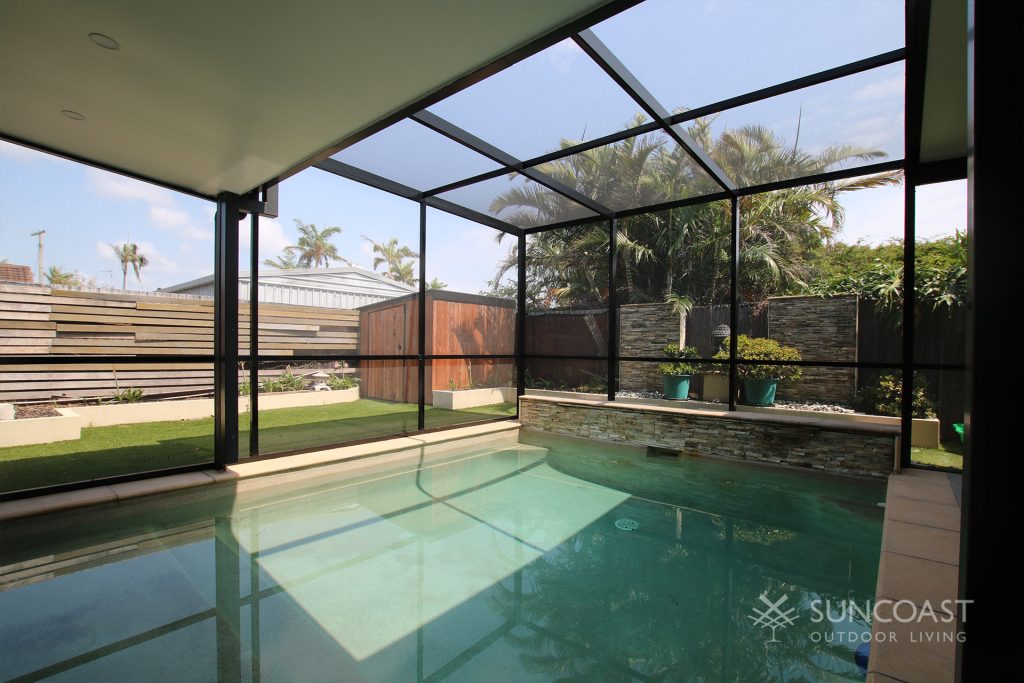
Visibility comes down to more than just the mesh. Mesh construction, screen colour and frame design all influence how open an enclosure feels. Our screens are standard black because darker mesh minimises light reflection and maximises clarity of view. Wider mesh widths and thoughtful frame placement also reduce visual interruptions across a span.
Where visibility is the priority, the mesh itself also makes a difference. The BetterVue Screen is designed to maximise visibility, with 33% more insect protection, 15% more openness, 10% more sunlight and an improved wind-load rating. It is not recommended for high-traffic areas, so it suits positions where the view is the priority and the mesh will not take physical pressure.
Our customer Kathy Fleming, who had her verandah screened, told us the screens are unobtrusive and do not affect her view, and that the household went from not sitting outside because of mosquitoes to using the space every day. That is the outcome most homeowners are looking for: solving the insect problem without losing the reason they enjoyed the space.
Which patio screen is right for your situation?
“Mosquitoes and flies are stopping us from using our patio.” Standard insect screening will usually handle it, and its low shade factor keeps the space bright and airy. Spend your attention on the perimeter seal and the doors rather than on upgrading the mesh.
“Midges are our biggest problem.” The finer midge weave is usually the answer, and location is often the giveaway: waterways, canals, wetlands and bushland are where midges shift from nuisance to the reason a space goes unused. Accept the higher shade factor only if midges are genuinely your problem rather than a precaution.
“We want an outdoor area our pets can enjoy.” The pet mesh is built for the physical pressure pets apply. Think about the specific animal rather than pets in general, since a determined large dog and a placid indoor cat need different answers. If a pool is involved, the Tuffscreen may solve two problems at once.
“We want to screen our pool area.” Start with compliance, not mesh. Both screens work in a compliant barrier, so the choice comes down to whether insects or durability is your bigger concern. Access design is where the compliance questions arise, so raise it early. Keeping leaves and debris out is a secondary benefit that owners often end up valuing most.
“We have a great view and don’t want to lose it.” The BetterVue mesh is built for exactly this. Also ask about frame placement and panel sizing, since large uninterrupted panels preserve sightlines far better than sections broken up by rails. Airflow and visibility tend to move together, so a more open weave serves both.
If your situation spans more than one of these, a site assessment is usually worth more than a product list.
Don’t choose the screen in isolation
Mesh solves insect, debris and containment problems. Treating the screen as the whole answer is how people end up disappointed with an otherwise good outdoor enclosure.
A screened enclosure is not a weatherproof room. Screens are not water-resistant, though they do cut the amount of wind-driven rain reaching the space, which often gives a patio back some usable floor area. Anything beyond that comes from the roofing, blinds and wall systems around it.
Need more shade or privacy? Consider blinds
Screens and blinds do different jobs. Screening handles insects, containment and airflow depending on the product. Blinds handle low-angle afternoon sun, glare, privacy and extra weather exposure depending on the system.
Western sun late in the day is the classic example: no insect mesh stops light at that angle, but a blind does. There is a fuller comparison in our guide to why the right combination of blinds and screens makes a difference.

Worried about heat? Look beyond the mesh
Heat control depends more on orientation, roof construction and direct sun exposure than the mesh itself.
Two screens in our range address heat directly: the 20×30 Solar Insect Screening stops up to 65% of the sun’s heat while still providing insect protection, and the 40×40 Super Solar Screening blocks up to 90% for the hottest, most exposed positions.
Beyond mesh, insulated roofing changes the thermal performance of the whole space, while 50mm insulated wall panels can create solid sections for BBQ areas, TV mounting or additional privacy. They can also help reduce noise transfer.
Think about airflow and ventilation
Screen mesh density affects airflow. The finer the weave, the more you ask of the breeze getting through it, which is why the tightest mesh is not automatically the best choice.
Good ventilation also comes down to how air enters and leaves the enclosure rather than treating it as a sealed box, and to designing around how you use the space across the year rather than the month you happen to be planning the build. Ceiling fans can make a noticeable difference during still conditions.
Plan your doors and access points
Doors are usually where enclosures succeed or fail in daily use. Think about how people move between house, enclosure, garden and pool, and how often. Wider doors suit entertaining and moving furniture. Self-closing doors are useful¸where children are involved. One of our customers, Rose Dinning, told us that after having her patio enclosed, she no longer gets a house full of flies when the children leave the door open behind them.
Swing doors, sliding doors and pet doors each change how the enclosure works. Getting them in the right position is a design decision, not an accessory bolted on at the end.
Real examples: how different screen choices solve different problems
Kenmore deck: midges without losing light or access
Problem: Flies and midges made a large entertaining deck unusable, but the family did not want to lose light, airflow or the back stairs to the yard.
Design choice: Midge screen, planned around the existing deck layout so the stairs stayed accessible.
Outcome: The deck became the family’s main entertaining space, with light, breeze and yard access unchanged.
View the Kenmore project.
Rothwell patio: when screening alone was not the answer
Problem: An outdated area with no protection from sun, bugs or weather. Heat was as much the problem as insects, so screening alone could not have solved it.
Design choice: Insulated flyover patio roof combined with full screening, sliding doors and fans.
Outcome: A year-round space with bugs, snakes and wildlife kept out, natural airflow retained and the view across the pool preserved.
View the Rothwell transformation.
Tamborine Mountain pool: debris, maintenance and the view
Problem: Prevailing winds dropped constant leaf matter into a 13×6 in-ground pool, and a mesh cover had to be dragged off for every swim. The property also runs as an Airbnb with guest pool access, and the Scenic Rim views could not be compromised.
Design choice: Screened pool enclosure with swing doors, replacing the aging pool fence.
Outcome: Leaves, branches and ducks kept out, reduced chemical usage, an extended swimming season and far less maintenance.
View the Tamborine Mountain project, or browse more screened outdoor areas in our before and after gallery.
Questions to ask before choosing your patio screen
• What insects or pests am I actually trying to keep out, and are any of them small enough to pass through standard mesh?
• Will the screen need to withstand pets or children pushing against it?
• Is the enclosure connected to or surrounding a pool?
• How important are uninterrupted views, and where exactly do I look from?
• How much airflow do I want to keep?
• Do I also need shade or privacy, and at what time of day?
• How will people and pets enter and exit, and how often?
• Are any sections exposed to strong afternoon sun or heat?
• How do I use this space now, and how would I like to use it once enclosed?
The answers determine both the screen and the enclosure design around it. If you are unsure which combination suits your home, we can assess the outdoor area, discuss how you want to use it, and recommend appropriate screening and enclosure features. Get in touch for a quote.
Choosing the right screen starts with the right enclosure design
There is no one-size-fits-all screen, and the right one starts with understanding how you want to use the space. Once insect pressure, pets, pool requirements and climate are clear, the right mesh and enclosure design usually become much easier to determine. Weigh those factors together rather than one at a time, because the answers interact, and remember that the screen is one component of an enclosure that also involves framing, roofing, doors and ventilation.
We design and install custom patio enclosures, alfresco enclosures and pool enclosures across Brisbane, the Gold Coast, Ipswich, the Sunshine Coast, Logan and surrounding South East Queensland.
Contact Suncoast Outdoor Living to talk through your outdoor area, compare the screen options that suit it, and request a personalised quote.
Frequently asked questions
How do I decide which patio screen I need?
Work out which insects you are dealing with, whether pets or children will put pressure on the mesh, whether a pool is involved, how much you value views and airflow, and how you want to use the space once it is enclosed. Those answers narrow the screen choice quickly, and they also determine the doors, roofing and ventilation the enclosure needs.
What type of screen is best for keeping mosquitoes and midges out?
Standard insect screening handles mosquitoes and flies. Midges and sand flies are smaller and need a tighter weave, which is what the 20×20 Midge Screen is designed for. No screen eliminates every insect, and how well the enclosure is sealed matters as much as the mesh itself.
Can I have pet-resistant screens without blocking my view?
Yes, with a trade-off. The 17×13 Tuffscreen Pet Mesh is heavy-duty and tear-resistant, at a 42% shade factor. Visibility also depends on design: uninterrupted panels, wider mesh widths and black screen colour all preserve sightlines. Whether it suits your particular view is worth checking on site.
Can screens around a pool form part of a pool-safe enclosure?
Two of our screens can form part of a compliant pool barrier when installed with our aluminium extrusion and spline system, and a Form 15 confirming compliance with AS1926.1-2007 is issued on completion.
Will enclosing my patio with screens reduce airflow?
Screens are designed to let air through, and customers regularly describe keeping doors open and still feeling the breeze after enclosing a space. Mesh density does affect airflow, so a 20×20 Midge Screen is less open than an 18×14. If airflow is a high priority, that shapes both the screen choice and whether fans are worth including.
Can I combine patio screens with blinds, insulated panels or fans?
Yes. Screens, blinds, insulated roofing, wall panels and fans solve different problems, and combining them is often the best approach when you need insect protection plus shade, privacy or temperature control.

